
Stable Logistics as the Foundation of Laser Electronics Manufacturing
In laser electronics manufacturing, production success depends less on speed and more on stability, accuracy, and continuity. Laser modules, optical components, control units, and precision electronic parts all require highly reliable material flow between warehouse and production lines. Any delay or mismatch can directly affect yield rates and delivery schedules.
As production capacity expanded, a Shenzhen-based laser electronics factory found that traditional manual material handling could no longer support its operational rhythm. Although the warehouse and production lines were physically close, high-frequency transport, multiple material categories, and strict timing requirements made manual delivery increasingly unreliable. Safety concerns also grew as equipment density and personnel movement increased inside the facility.
Deploying Reeman AMR Robots for Point-to-Point Delivery
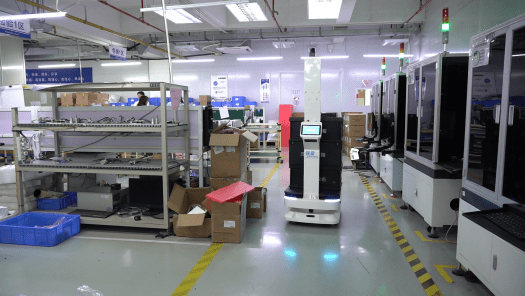
To address these challenges, the factory introduced Reeman AMR robots from the Spaceship Series with a 300 kg payload and lifting capability. These AMR robots were deployed to handle point-to-point transport between the warehouse and production lines, directly interfacing with standard material racks and turnover carts.
By eliminating manual loading and unloading, the factory reduced human intervention and minimized variability in the material supply process.
Autonomous Navigation in Complex Production Environments
Reeman AMR robots operate using autonomous navigation without requiring magnetic strips or extensive site modifications. They quickly adapted to the existing factory layout and navigated safely through intersecting aisles and dense equipment zones.
The robots continuously detect people, carts, and temporary obstacles, dynamically adjusting their routes to maintain safe and stable operation without interrupting sensitive laser production processes.
Improving Production Continuity and Logistics Control
With point-to-point automated delivery in place, the logistics relationship between the warehouse and each production stage became clearly structured. Once production orders are issued, Reeman AMR robots automatically execute pickup, transport, and delivery tasks with high accuracy.
Multiple robots can be dispatched simultaneously to support parallel workstations, reducing bottlenecks and protecting critical production rhythms.
Results and Operational Impact
After deployment, the factory achieved high-frequency automated material transport without increasing labor. Material response speed and delivery accuracy improved significantly, while logistics operations became data-driven and fully traceable.
With its stable performance, easy deployment, and safety advantages, the Reeman AMR robot has become a key enabler of intelligent manufacturing upgrades in the laser electronics industry.
더 보기: 리만봇

How Can Autonomous Forklifts Turn Existing Stretch Wrappers into Automated Packaging Workstations?

자율주행 지게차는 자동문 및 스트레치 래퍼와 어떻게 통합될 수 있을까? REEMAN 공장 사례 연구

REEMAN Titan Mini가 맞춤형 포크로 비표준 탱크 트롤리를 처리하는 방법

배달 로봇은 아파트 건물에서 어떻게 엘리베이터를 이용할 수 있을까? REEMAN YIMA 설명

REEMAN, 전문 테니스 시설을 위한 상업용 자율 테니스 볼 수거 로봇 출시 예정

Humanoid Robot Prices: What the Current Generation Costs and Why