
Reeman AMR Robot Enables Stable and High-Efficiency Logistics in Automotive Parts Manufacturing
게시일

Production Rhythm as the Core Challenge in Automotive Parts Logistics
In the automotive parts manufacturing industry, production complexity is significantly higher than in standard electronics assembly. Multi-variety components, small batch sizes, and frequent process switching have become the norm. Once internal logistics fall behind, overall production scheduling and delivery timelines are immediately affected.
After expanding its production capacity, a large automotive parts factory in Shenzhen identified internal logistics restructuring as a priority for sustaining stable operations.
Limitations of Manual Material Handling
The factory operates across multiple workshops, including injection molding, machining, and assembly. Components vary widely in specifications and circulate frequently between processes. Previously, material transport relied mainly on manual carts, resulting in random routing, unstable efficiency, and frequent congestion during peak periods.
Management recognized that simply adding labor could not solve these systemic issues. A smarter, more structured logistics approach was required to rebuild material flow efficiency.
Deploying Reeman AMR Robots for Workshop Logistics
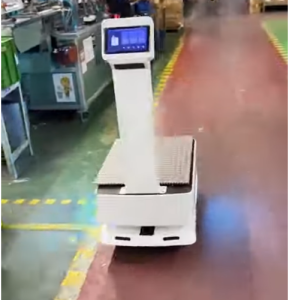
After evaluating multiple solutions, the factory introduced Reeman AMR material handling robots from the Big Dog Series with a 100 kg payload. These robots were deployed for standardized internal material transport within the workshop.
Unlike traditional automation systems, Reeman AMR robots require no fixed tracks or large-scale infrastructure changes. They can be flexibly deployed based on existing process layouts, allowing rapid integration into the current production system.
Building Predictable and Stable Material Flow
Once operational, Reeman AMR robots followed predefined process routes between storage areas and processing stations, creating a stable and predictable material flow rhythm. The system dynamically adjusts delivery frequency based on production plans, reducing uncertainty caused by manual scheduling.
In space-constrained automotive workshops, the robots’ stable operation in complex aisles also significantly reduced safety risks associated with mixed traffic between workers and equipment.
Operational Results and Long-Term Value
With internal logistics becoming more standardized, the factory achieved an overall improvement in material turnover efficiency without increasing manpower. The introduction of Reeman AMR robots transformed logistics from passively reacting to production needs into actively supporting production planning, laying a solid foundation for future capacity expansion.
더 보기: 리만봇

How Can Autonomous Forklifts Turn Existing Stretch Wrappers into Automated Packaging Workstations?

자율주행 지게차는 자동문 및 스트레치 래퍼와 어떻게 통합될 수 있을까? REEMAN 공장 사례 연구

REEMAN Titan Mini가 맞춤형 포크로 비표준 탱크 트롤리를 처리하는 방법

배달 로봇은 아파트 건물에서 어떻게 엘리베이터를 이용할 수 있을까? REEMAN YIMA 설명

REEMAN, 전문 테니스 시설을 위한 상업용 자율 테니스 볼 수거 로봇 출시 예정

Humanoid Robot Prices: What the Current Generation Costs and Why